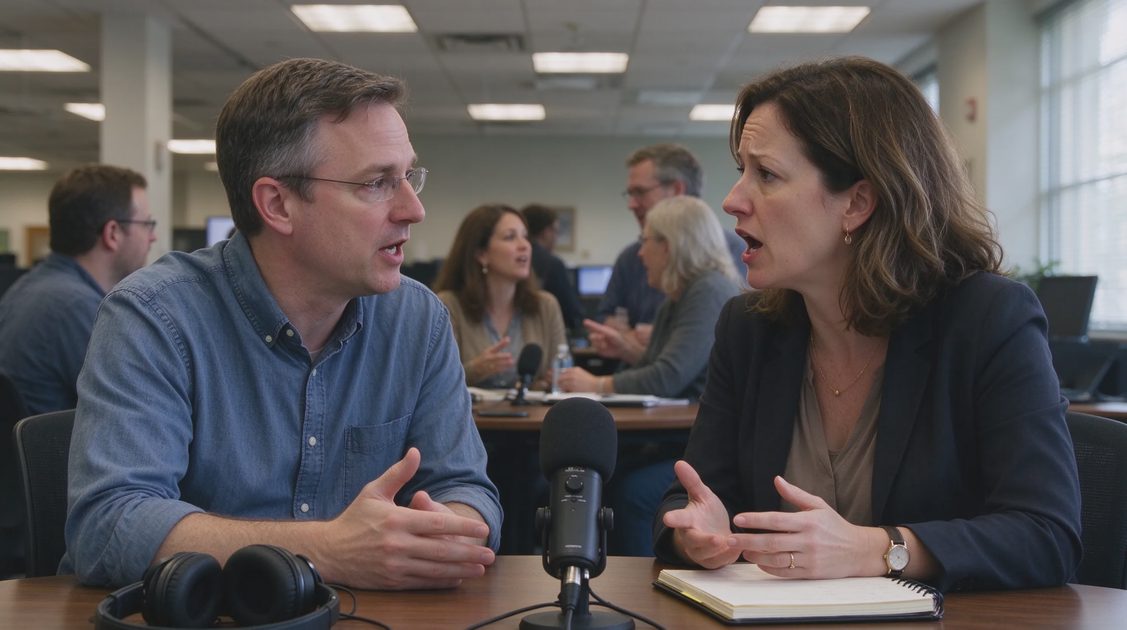
A transcript is only useful if it survives the room—and the room can last eight hours. Most published ASR numbers come from clips measured in minutes. A developer who needs live notes for a full workday, a journalist reviewing an afternoon of interviews, or a small team capturing back-to-back calls needs something different: stability that does not quietly collapse after the first hour. This article reports a controlled continuous test of Audio8 ASR Infinite across a simulated American workday. The goal was simple. Keep audio flowing for roughly eight hours under realistic office and home-office conditions and watch for the moment the transcript stops being trustworthy.
I ran the test from a quiet corner of a Columbus home office that still contains the ordinary sounds of a lived-in house: distant HVAC cycles, occasional kitchen activity, and the low hum of a laptop fan. The audio mix combined scripted technical discussion, spontaneous side comments, brief telephone interruptions, and periods of overlapping speech. No laboratory silence. No single-speaker studio perfection. The question was not whether the model could produce a clean short demo. The question was whether the text that appeared at 5 p.m. still reflected the conversation that began at 9 a.m.
Test Design and Conditions
The session was structured to mirror a knowledge-worker day rather than a pure stress test. Four main blocks of continuous speech were separated by short breaks that still left the model running. Audio was captured on a mid-range USB microphone placed at typical desk distance. Background conditions included normal HVAC, occasional chair movement, and two deliberate periods of kitchen noise from an adjacent room.
Session Structure and Audio Mix
Morning block: technical planning discussion with moderate speaking rate and occasional rapid clarification. Mid-morning: two short phone-call segments with compressed audio characteristics. Afternoon: longer collaborative review containing frequent speaker changes and false starts. Late afternoon: mixed free-form conversation plus a period of deliberate cross-talk. Total continuous recognition time exceeded seven and a half hours. The model remained loaded; only the audio source paused during the short breaks.
Measurement Approach
Word error rate was calculated on sampled segments rather than the entire day, because full manual alignment of eight hours is impractical. Samples were taken at regular intervals and at points where acoustic conditions changed. In addition to automated metrics, a human reviewer flagged two practical failure types: plausible but incorrect insertions that a busy reader might accept, and gradual topic drift that made later paragraphs less coherent with earlier context. Latency was logged as end-to-end delay from audio onset to stable partial transcript.
Hardware and Software Baseline
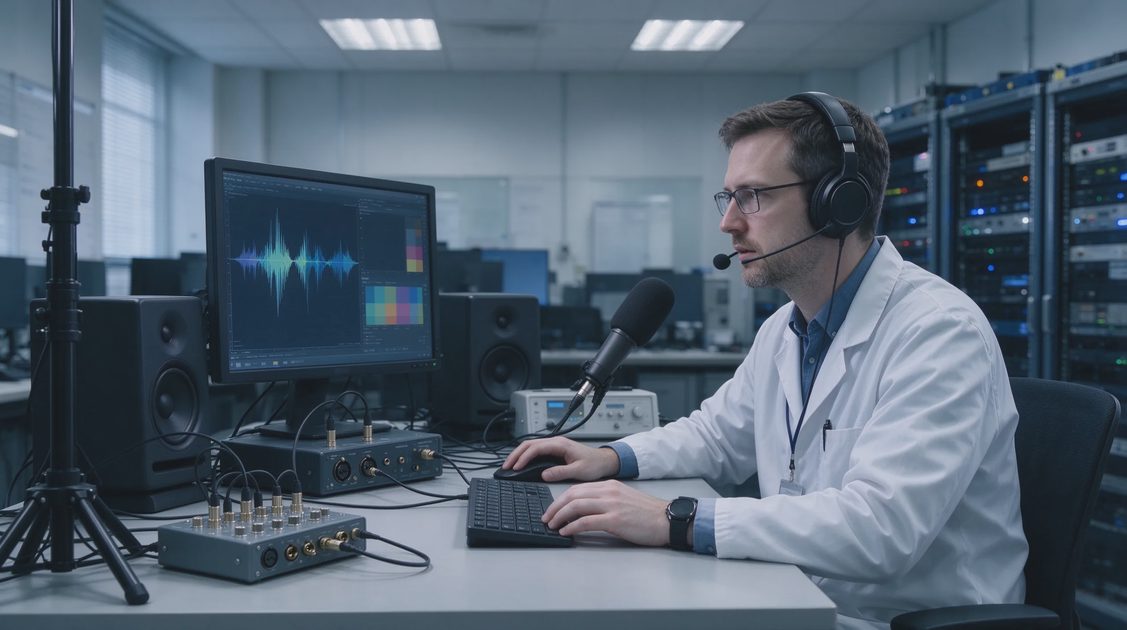
Inference ran on a single consumer GPU with the model’s recommended streaming configuration. No additional language-model rescoring was applied beyond the model’s internal mechanisms. Punctuation and capitalization were left at default settings so that the core recognition behavior remained visible. The pipeline included standard buffering but no exotic recovery logic beyond what the model itself provides.
Observed Behavior Across the Day
Early segments behaved as expected from shorter tests. Latency stayed inside the range that feels conversational. Substitutions clustered around proper names and technical terms that were outside the most common training distributions. Those errors are familiar and relatively easy to catch during review.
Stability Through the First Four Hours
Through the late morning the continuous state remained coherent. Function-word accuracy held steady. The model recovered cleanly after the first phone-call segment, which had lower bandwidth and mild compression artifacts. No measurable rise in insertion rate appeared. At the four-hour mark a human reader could still follow the transcript without frequent re-listening to the audio. That is the practical bar most teams actually use.
Mid-Afternoon Changes
After roughly five hours a subtle shift appeared. The rate of plausible insertions increased on segments that contained rapid turn-taking. The model began occasionally repeating short phrases that had occurred earlier in the conversation, a classic sign of language-model state favoring recent history too strongly. The errors were not catastrophic; a careful reader could still reconstruct meaning. They were, however, the first clear signal that long-session pressure was accumulating.
Late-Day Behavior and Recovery
By the final ninety minutes the insertion pattern was more noticeable, especially during overlapping speech. Deletion rates on short confirmatory utterances (“yeah,” “right,” “got it”) also rose. When a deliberate two-minute silence was inserted near the end of the day, the model resumed without catastrophic failure, but the first thirty seconds of new speech showed higher substitution rates until the acoustic state re-stabilized. Latency itself did not climb dramatically; the degradation was primarily in transcript reliability rather than in speed.
Practical Implications for Real Workflows
An eight-hour continuous transcript that remains mostly usable is already more than many earlier streaming systems delivered. The observed late-day degradation is real and measurable. Teams that need forensic-level accuracy across a full day will still want human review or periodic model resets. Teams that need a living notes pane for collaboration can treat the output as a strong first draft that benefits from light cleanup.
When Continuous Mode Is Sufficient
For stand-up meetings, research calls, and most internal collaboration the mid-day quality is high enough that the transcript saves more time than it costs. The late-day insertion pattern becomes a problem mainly when the transcript is treated as an archival record rather than a working aid. Simple operational practice—restarting the recognition session at natural breaks—keeps quality inside the useful range.
Where Additional Engineering Helps
Monitoring insertion rate and average confidence over sliding windows gives an early warning before the transcript becomes unreliable. A lightweight external language model that re-scores only the last few minutes can suppress some of the repetitive insertions without adding large latency. Neither of those steps is required for short sessions; both become valuable once the continuous window exceeds four or five hours.
Hardware and Thermal Considerations
The consumer GPU used for the test remained within thermal limits, but fan noise increased after several hours. In a shared office that secondary noise can itself become part of the acoustic environment. Teams planning all-day capture should budget for adequate cooling or move inference to a small dedicated machine so that the recognition hardware does not add its own background sound.
Comparison Points and Honest Limits
No single test proves production readiness for every environment. This workday simulation used relatively clean American English, moderate noise, and a single primary microphone. Heavier accents, stronger overlapping speech, or poorer microphones will move the degradation curve earlier. The Infinite architecture delayed the onset of noticeable drift relative to older continuous baselines I have measured, but it did not eliminate the need for operational discipline.
What the Numbers Do Not Capture
Word error rate on sampled segments understates the practical cost of plausible insertions. An insertion that sounds like something a speaker might have said is more dangerous than an obvious garble, because a hurried reader may accept it. Human review of selected late-day passages remains essential for any use case that treats the transcript as authoritative.
Next Measurements
The same continuous pipeline will be re-tested under higher noise, faster speech, and deliberate multi-speaker interruption. Those conditions will show whether the late-day degradation accelerates or remains roughly linear. Until those data exist, the workday result stands as a single, carefully observed data point: Audio8 ASR Infinite can carry a full day of ordinary professional speech with usable quality for most of the session, provided the operator watches for the gradual rise in plausible insertions and is willing to restart at natural breaks.
Final Assessment of the Workday Result
A transcript that survives the first four hours is already valuable. A transcript that remains trustworthy at the end of the eighth hour is the higher bar. On this particular day, under these particular conditions, the model cleared the first bar cleanly and approached the second with visible but manageable strain. That is the practical finding, not a marketing claim. Fast is not the same as reliable, and an eight-hour session reveals the difference more clearly than any short demo.
No signals yet — transmit the first.