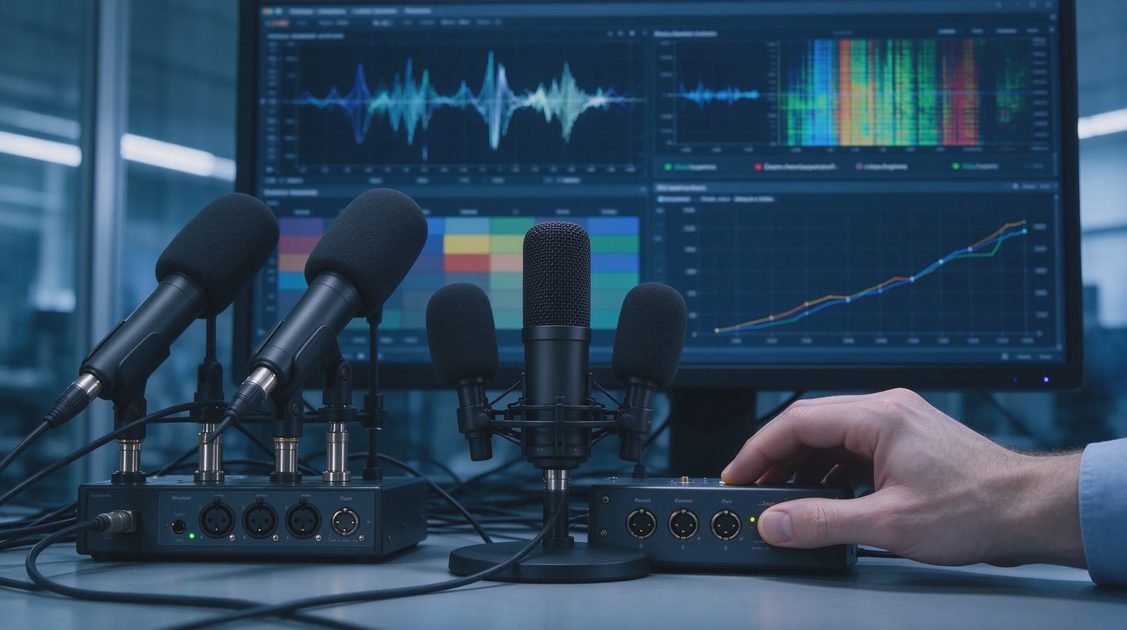
A transcript is only useful if it survives the room. That single rule has shaped every evaluation I have run for the past three years. Most speech models look impressive in a quiet demo. They falter when the coffee grinder starts, when someone talks over the HVAC, or when a conversation stretches past the length of a benchmark clip. Audio8 ASR Infinite is marketed as a continuous, low-latency streaming system built for exactly those conditions. Before we measure drift, latency, or microphone placement, we need a plain-language account of what the model actually is, what “infinite” claims, and where the engineering boundaries still sit.
I am writing this from Columbus, Ohio, after years of testing voice interfaces for logistics dispatch, healthcare scheduling, and customer-support floors. Those environments taught me that a model’s paper score matters less than whether the transcript remains coherent after forty-five minutes of overlapping speech and ordinary American room noise. This article stays inside that frame. No launch-day adjectives. No claim that the system understands everything. Just a practical description of the architecture, the streaming behavior, the deployment surface, and the failure modes that show up once the studio lights turn off.
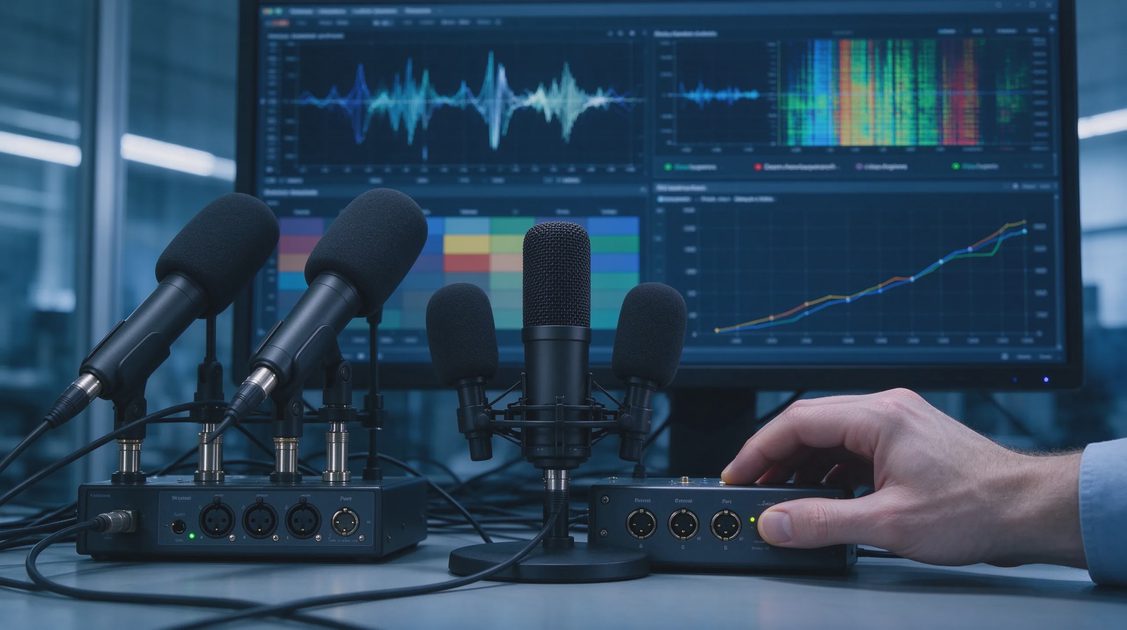
The Core Promise of Continuous Streaming ASR
Audio8 ASR Infinite is designed as a streaming speech-recognition system rather than a batch transcriber. In a batch system you record, upload, and wait. In a streaming system audio arrives in small chunks, the model updates its internal state, and partial transcripts appear with minimal delay. The “Infinite” label points to the design goal of long-session stability: the model is meant to keep producing usable text across hours without the gradual degradation that older streaming systems showed after twenty or thirty minutes.
How Streaming Differs from Offline Transcription
Offline models process an entire file at once. They can look ahead and revise earlier words once later context arrives. Streaming models cannot wait. They must emit hypotheses on partial evidence, then revise those hypotheses as more audio arrives. That revision process is why you sometimes see words flicker or correct themselves a second or two after they first appear. The engineering trade-off is speed versus final accuracy. Audio8 ASR Infinite exposes controls for how aggressive those partial hypotheses can be, which matters when the output is feeding a live caption display or a real-time note-taking tool.
What “Infinite” Actually Constrains
No model is literally infinite. Memory, compute, and acoustic state all have limits. In practice the claim means the system is engineered to avoid the classic failure mode in which recognition quality collapses after a long stretch of continuous audio. Older pipelines often accumulated silence-detection errors or drifted in their internal language-model state. The Infinite design tries to keep the acoustic and language states reset-friendly so that an hour-long meeting does not produce worse text in the last fifteen minutes than in the first. Whether that holds under real conditions is a measurement question, not a marketing one. We will test it directly in later articles.
Latency Targets and Why They Matter to Ordinary Users
Vendors often quote median latency numbers under ideal conditions. For a conversation, the number that matters is the delay a listener actually feels. At roughly 80–120 ms the lag is rarely noticed. Around 200 ms many people start to sense that the text is trailing the voice. Beyond 400 ms the experience becomes distracting for live collaboration. Audio8 ASR Infinite’s published targets sit in the lower range when the pipeline is correctly tuned, but those numbers only appear when audio buffering, network hops, and post-processing are kept under control. A local deployment can hit the low end; a cloud round-trip plus heavy punctuation model can push the same model into the higher band.
Architecture at a Practical Level
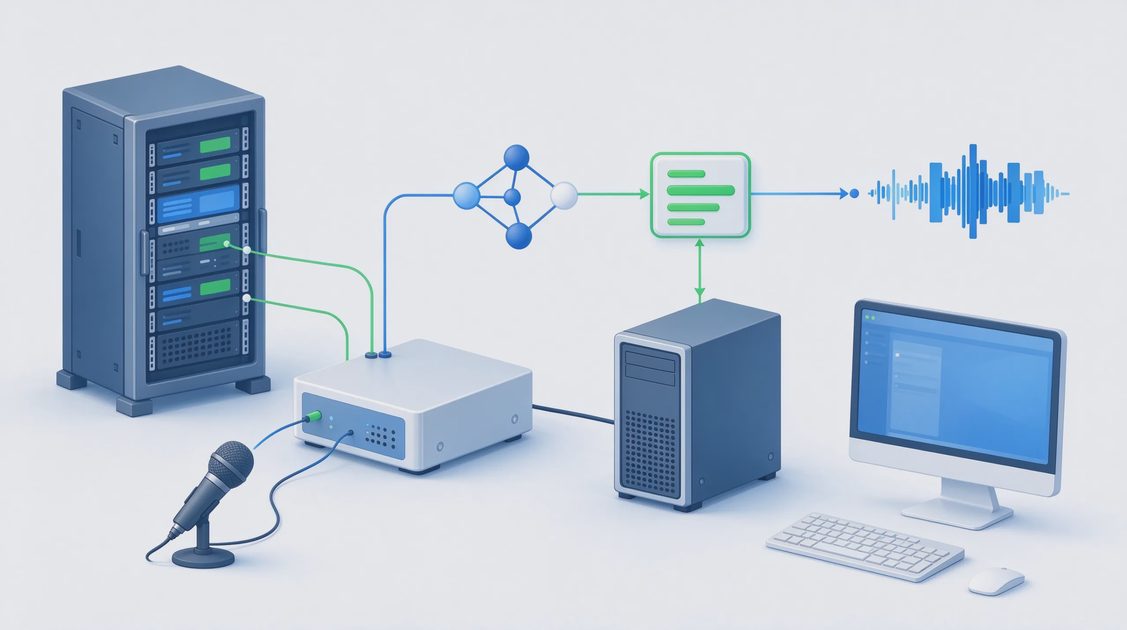
Understanding the pieces helps you decide whether the system fits a given workflow. The high-level pipeline is familiar to anyone who has worked with modern ASR: feature extraction, encoder, decoder or transducer, and optional language-model rescoring. The continuous-specific parts live in how state is carried across chunks and how the system recovers from brief audio dropouts.
Audio Front-End and Chunking
Incoming audio is typically windowed into short overlapping frames. The exact frame size and hop length affect both latency and stability. Too short and the model sees almost no context; too long and the delay climbs. Audio8 ASR Infinite’s recommended configurations favor shorter frames for responsiveness while relying on the internal state to maintain coherence. In a home or small-office setting the front-end also has to tolerate ordinary microphone characteristics—built-in laptop mics, inexpensive USB condensers, or phone headsets—rather than laboratory-grade arrays.
Streaming Encoder and State Management
The encoder converts acoustic features into a sequence of representations. In a continuous system those representations must remain consistent across successive chunks. Drift appears when the encoder’s internal statistics slowly shift or when the language model begins to favor earlier topics too strongly. The Infinite design includes mechanisms intended to keep those statistics stable. In evaluation we watch for two concrete symptoms: increasing substitution rates on common function words, and growing numbers of insertions that sound plausible but were never spoken. Both are early signs that the continuous state is no longer trustworthy.
Output Formatting and Downstream Handoffs
Raw token sequences are rarely the final product. Most real deployments add punctuation, capitalization, speaker labels, or timestamps. Each of those stages adds latency and can introduce new errors. Audio8 ASR Infinite provides hooks for these stages so that developers can decide how much post-processing is acceptable for a given use case. A live captioning tool may accept lower punctuation quality in exchange for lower delay; a meeting-notes pipeline may prefer cleaner final text even if it arrives a few hundred milliseconds later.
What the Model Is Not
Clear boundaries prevent disappointment. Audio8 ASR Infinite is not a general-purpose conversation agent. It does not maintain long-term dialogue memory the way a large language model does. It is not a diarization system by itself, although it can be paired with one. It does not magically remove the need for decent audio capture. And it does not eliminate the engineering work of monitoring, buffering, and recovery when the network or the microphone misbehaves.
Limits on Acoustic Robustness
No current open or commercial ASR system is immune to heavy overlapping speech, extreme noise, or heavily accented rapid talk. The Infinite model improves on earlier baselines in many of these conditions, but the improvement is measured in percentage points of word error, not in the elimination of error. In a typical American kitchen with a blender running and two people talking, you should still expect substitutions and deletions. The practical question is whether the remaining errors still leave a usable record of what was said.
Privacy and Data Boundaries
Because the system can run locally, it offers a path that keeps audio on the user’s machine. That is a genuine advantage for teams handling sensitive conversations. Local execution does not remove the need for careful logging, retention policies, and access controls. A transcript that never leaves the building can still become a liability if it is stored indefinitely or shared too widely inside the organization.
How This Fits Everyday American Workflows
Developers and small teams in the United States rarely need laboratory perfection. They need a system that can keep up with a stand-up meeting, a research interview, or a podcast recording session without forcing constant manual cleanup. Audio8 ASR Infinite’s design target sits closer to those practical loads than to pure academic benchmarks.
Meeting and Collaboration Settings
In a hybrid office the model can feed a live notes pane. The value appears when the transcript remains coherent across speaker changes and brief side conversations. Drift that slowly turns “action items” into “action items” with extra invented words destroys trust. Early tests suggest the Infinite architecture reduces that particular failure mode relative to older continuous systems, but the reduction is not absolute.
Interview and Field-Recording Use
Journalists, researchers, and accessibility specialists often work in uncontrolled rooms. A model that recovers quickly after a door slam or a phone notification is more useful than one that posts a higher clean-room score. The continuous design’s emphasis on state stability is relevant here. Later articles will measure recovery time after common interruptions.
Measuring What Matters Next
This explanation is only the starting point. The next articles will put the same model into concrete American environments: a full workday of continuous audio, measured latency at different clock settings, a one-hour room test, kitchen noise, regional accents, and overlapping speakers. Each test will report both automated metrics and human review of the final transcript.
Until those measurements exist, the honest summary is straightforward. Audio8 ASR Infinite is a streaming speech-recognition system built for long sessions and relatively low latency. It improves on earlier continuous pipelines in several practical dimensions. It still requires careful audio capture, thoughtful deployment, and ongoing monitoring. A transcript remains useful only when the text that arrives at the end of the hour still matches the conversation that actually happened. That is the standard this series will apply.

No signals yet — transmit the first.