A transcript is only useful if it survives the room, and most published speech-recognition benchmarks never enter the room. They report word error rate on clean, short, carefully collected test sets that differ systematically from the acoustic, conversational, and temporal conditions American developers and teams actually face. Headline numbers therefore frequently overstate readiness for continuous transcription. This article provides a detailed, practical method for reading benchmarks so that the numbers inform rather than mislead decisions about systems such as Audio8 ASR Infinite.
The method is the same one applied throughout this series: always ask what was measured, under what acoustic and speaking conditions, for how long, with what latency profile, and what classes of error were examined or ignored.

Test-Set Composition and Systematic Domain Mismatch
The largest single source of misleading conclusions is mismatch between the benchmark data and the target use case.
Clean Read Speech Versus Everyday Conversational Speech
Many widely cited test sets emphasize read speech, scripted prompts, or carefully produced news-style audio. Continuous transcription of meetings, interviews, research calls, and home conversations is dominated by false starts, self-repairs, filled pauses, overlaps, and informal vocabulary. A model that achieves leading numbers on read-speech sets can still produce elevated deletions of short confirmations and hybrid sentences under ordinary conversational load. When the benchmark documentation does not clearly state the proportion of spontaneous versus read material, assume the number is optimistic for continuous use.
Accent, Age, and Demographic Coverage
Benchmarks that under-represent regional American accents, older speakers, children’s voices, or non-native but fluent English will over-state accuracy for any team whose users include those groups. Midwestern, Southern, and Northeastern patterns already produced measurable differences in earlier stress tests; broader demographic gaps are larger. Absence of clear speaker-description tables in the benchmark paper or leaderboard is itself a warning signal.
Noise, Reverberation, and Real-Room Acoustics
Laboratory noise and simulated reverberation rarely match the spectral shape, temporal modulation, or non-stationary character of American HVAC systems, kitchen appliances, open-office babble, or street noise through windows. Models that appear robust on synthetic noise can still degrade under the steady low-frequency energy and intermittent impulsive sounds of real homes and workplaces. Always check whether the noise conditions resemble the rooms you actually occupy.
What Most Benchmarks Omit or Under-Report
Streaming Latency and End-to-End Delay
Word error rate without latency is only half the story for continuous systems. A model can achieve low error by waiting for future context that a true streaming pipeline cannot see. Benchmarks that report only offline or generous-chunk decoding time leave the most important continuous variable unmeasured. Felt latency under realistic buffer settings, jitter, and concurrent load is what users experience.
Session Length and Continuous-State Behavior
The majority of public evaluations use segments measured in seconds or a few minutes. Continuous systems reveal late-session insertion growth, topic-bleed from earlier context, and recovery behavior only after tens of minutes or hours. A strong short-form score supplies almost no information about stability across a workday, a long interview, or a multi-hour research session.
Error Quality and Plausibility
Automated word error rate treats every substitution and insertion as equal. Human users do not. Plausible insertions that survive casual reading are more dangerous and more costly to catch than obvious garble. Benchmarks that never include even light human review of error quality under continuous conditions systematically understate real-world review burden.
Benchmark Claim | Critical Check | Common Misreading | Better Operational Question |
|---|---|---|---|
“X % WER on public test set” | Domain, accents, noise, spontaneity | “This will work in my meetings” | Does the test set match my actual rooms? |
“State-of-the-art accuracy” | Whether streaming latency was measured | “Ready for live use” | What is end-to-end latency under load? |
“Robust to noise” | Type, SNR, and realism of noise | “Kitchen and HVAC are fine” | Was real HVAC or appliance noise used? |
“Improved continuous recognition” | Session length and drift metrics | “No more late-session problems” | How does insertion rate behave after 60 min? |
“Human-level performance” | Task definition and error-quality review | “No further human work needed” | Are remaining errors plausible or obvious? |
Mapping Published Numbers onto Continuous Real-World Use
Maintain a Private, Matched Evaluation Set
The most reliable defense against misleading public numbers is a small private set that reflects actual acoustic conditions, speaking styles, overlap density, and session lengths. Even thirty to sixty minutes of carefully chosen audio from real meetings, interviews, or home conversations provides a better decision signal than an unmatched public leaderboard. Re-run the private set after every candidate model or configuration change.
Measure Latency Inside the Target Pipeline
Replicate the benchmarked model or configuration inside the actual capture, buffering, and display pipeline and measure end-to-end delay with realistic buffer sizes and concurrent load. The gap between claimed decoding time and felt latency is often large and is almost never visible in the original benchmark.
Inspect Error Types, Not Only Aggregate Rates
Sample the actual substitution, deletion, and insertion patterns, especially in late-session and high-overlap segments. If the remaining errors concentrate on proper names, domain terms, or overlapping speech, the practical remediation path (lexicon, placement, soft reset, human review) is different than if the errors are random or uniformly distributed.
Compare Under Matched Conditions
When evaluating two models or two configurations, keep capture hardware, placement, buffer settings, and session length identical. Otherwise differences in the audio front-end are routinely mis-attributed to the model.
A Practical Four-Question Reading Checklist
Before treating any benchmark number as decision-relevant for continuous transcription, answer these four questions in writing:
Does the test data match the domain, accents, noise profile, and speaking style of the intended use?
Was end-to-end streaming latency measured under realistic chunking, buffering, and load?
Were the evaluated sessions long enough to reveal continuous-state behavior and late-session drift?
Has anyone examined whether the remaining errors are predominantly plausible or obvious?
If the answer to any question is “no” or “unknown,” the number is incomplete for continuous-system decisions and should be treated as a lower bound on real-room difficulty rather than a direct predictor of performance.
Closing Observation on Benchmark Literacy
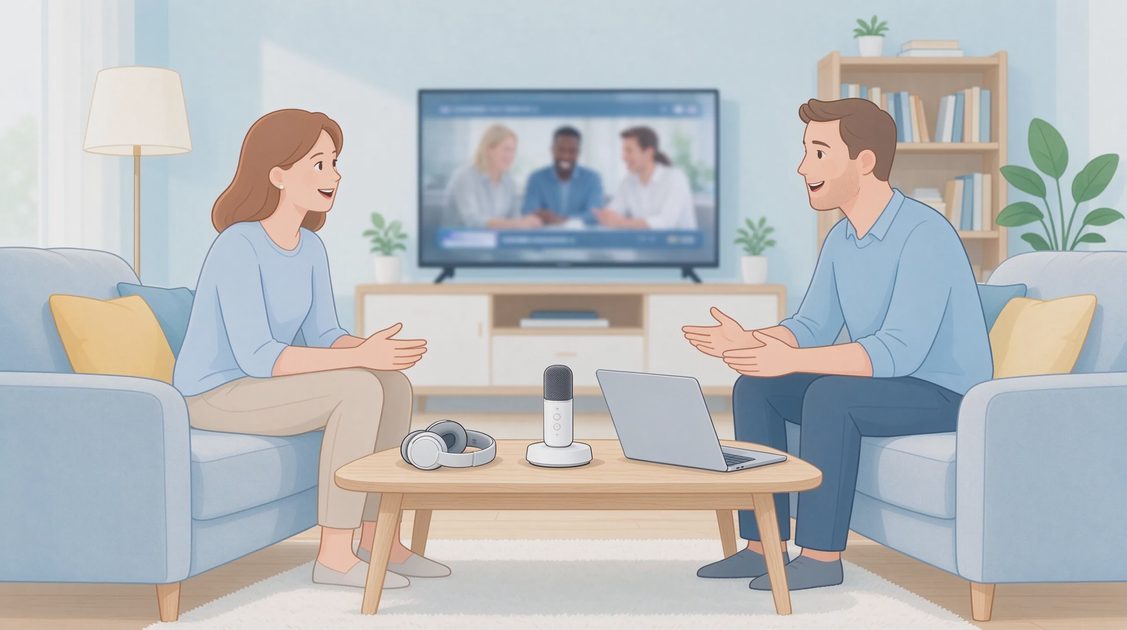
Benchmarks are useful when their limits are visible and their mismatch with the target room is acknowledged. They become actively misleading when headline word-error rates are treated as direct forecasts of performance in American meetings, interviews, classrooms, and homes. Continuous systems such as Audio8 ASR Infinite must be judged by survival in the room—latency under load, recovery after interruption, stability across real session lengths, and the quality of remaining errors—not solely by position on a short-form leaderboard.
The transcript still has to survive the room. Reading benchmarks critically is one of the practical skills that keeps developers and teams from discovering the mismatch only after users have already lost trust.

No signals yet — transmit the first.